
Call 860-526-0018, email Library@chesterct.org, or click the image to register online:
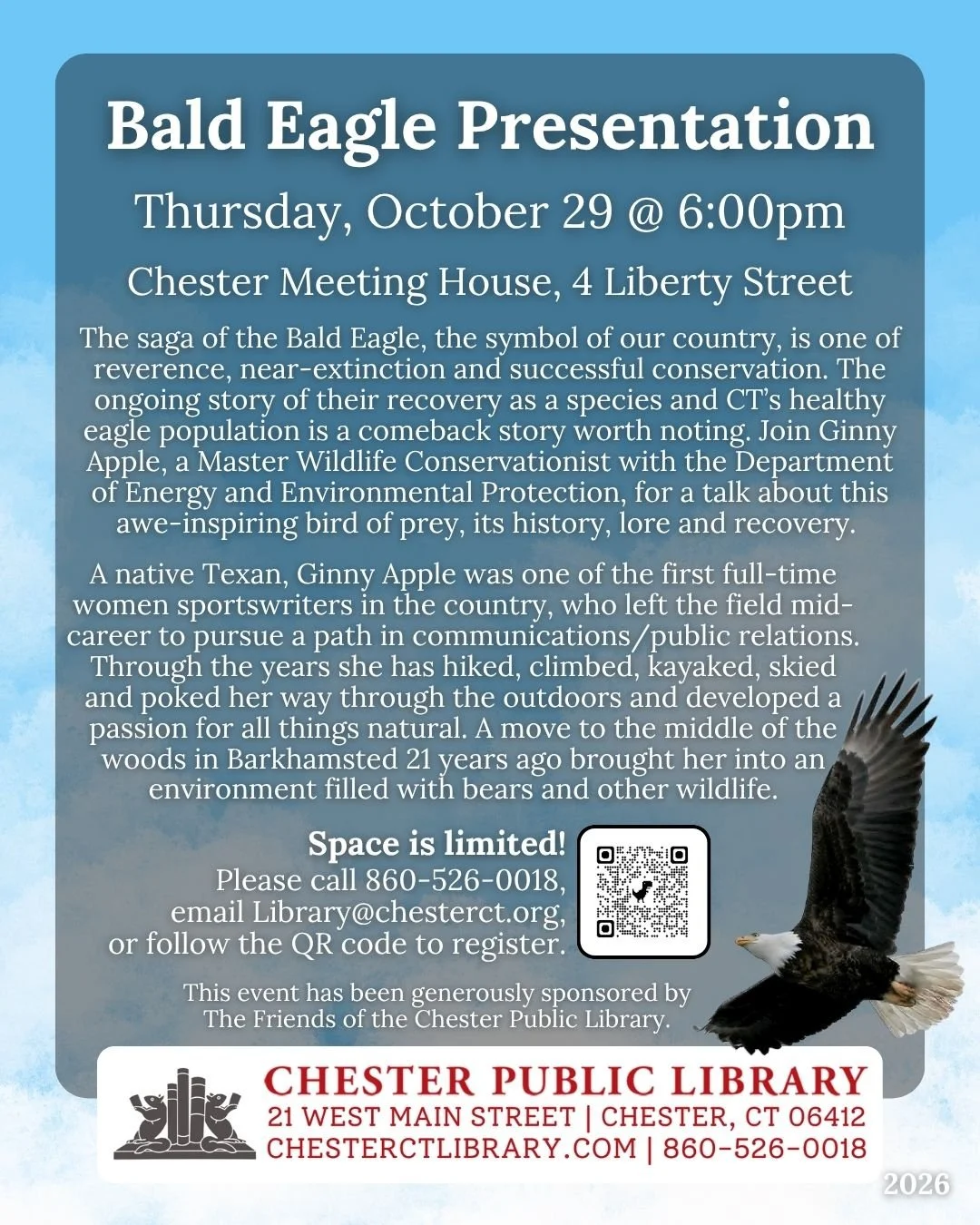
The history of America would not be complete without the soaring presence and remarkable saga of the Bald Eagle. Native to North America, this magnificent raptor evolved from an ancient spiritual and sacred bird to a symbol of the United States of America. Before the colonists appeared, indigenous cultures revered this mighty eagle and viewed it as a messenger connecting the living to higher spirits and lost ancestors.
When seeking a national emblem, the Continental Congress wanted something unique to their new country and, after nixing the suggestions of many unsuccessful committees, they approved the Bald Eagle be placed on the Great Seal of the United States, which was adopted in 1782, with the Bald Eagle at the center of the seal, clutching branches and arrows in its talons to signify the balance between peace and war.
Despite achieving the highest peak in American iconography, early settler and farmers loathed the Bald Eagle, and perceived it as a threat to livestock, commercial fisheries—even pets and infants. Humans hunted and trapped them, fed them to their hogs—even poisoned them throughout the 1800s. Once a species that numbered up to half a million country-wide, it soon dwindled to just 417 nesting pairs in the late 1960s because of earlier decimation and uncontrolled hunting, loss of habitat and the use of dangerous pesticides, such as DDT. By the time Congress finally passed the Bald Eagle Protection Act of 1940, the species had already seen massive declines.
The saga of the Bald Eagle, the symbol of our country, is one of reverence, near-extinction and successful conservation. The ongoing story of their recovery as a species and CT’s healthy eagle population is a comeback story worth noting. Join Ginny Apple, a Master Wildlife Conservationist with the Department of Energy and Environmental Protection, for a talk about this awe-inspiring bird of prey, its history, lore and recovery.
A native Texan, Ginny Apple was one of the first full-time women sportswriters in the country, who left the field mid-career to pursue a path in communications/public relations. Through the years she has hiked, climbed, kayaked, skied and poked her way through the outdoors and developed a passion for all things natural. A move to the middle of the woods in Barkhamsted 21 years ago brought her into an environment filled with bears and other wildlife.
Living in a 1760 house surrounded by Peoples State Forest, she observes a large population of Black Bears and supplies field notes and photographs on them to DEEP bear biologists. Her affinity for this magnificent creature led her out west to participate in a Grizzly research mission in Montana and to become a Master Wildlife Conservationist with the State Department of Energy and Environmental Protection, for which she gives over 100 talks yearly and volunteers monitoring the local bear population. As an MWC she also, along with many other activities, serves as a Bald Eagle interpreter for the Shepaug Dam Eagle Viewing area and the Essex Steam Train’s Eagle Flyer and created and runs the Barkhamsted Earth Day Nature Festival, a yearly event on the last Sunday in April that draws an average of 800 people to Peoples State Forest.
Ginny is Chair of the Barkhamsted Conservation Commission on the Boards of the Farmington River Watershed Association, the Litchfield Hills Audubon Society, the Northwoods Land Conservancy, the Friends of American Legion and Peoples State Forests and the Friends of Connecticut State Parks. She also maintains the Facebook pages for the Town of Barkhamsted, FALPS and the Barkhamsted Historical Society. Just to keep her creative juices percolating, she has a side business, Murder Without Pain, where she writes murder mystery games based on historical subjects and runs them at country inns, corporate parties and fundraisers.